
The strategic question is no longer how you rank for keywords—it is how you make your business understandable and actionable to agents.
1) The core idea
Picture a city map.
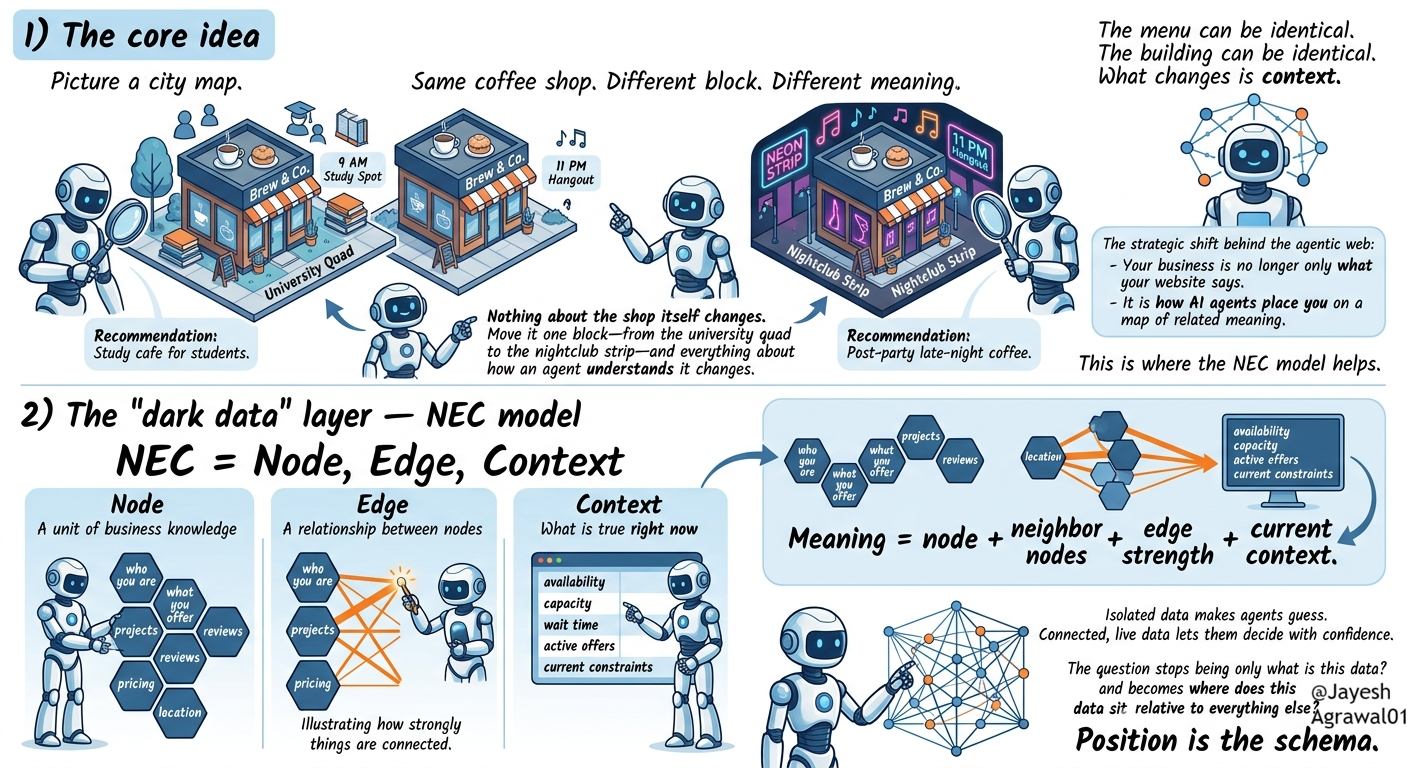
Same coffee shop. Different block. Different meaning.
Take Brew & Co.: same flat whites, same pastries, same hours, same staff. Nothing about the shop itself changes. Move it one block—from the university quad to the nightclub strip—and everything about how an agent understands it changes.
Location A · University district
Neighborhood: library, student union, lecture halls, campus bookshop, campus health.
How an agent reads the business: a productivity-adjacent caffeine stop for deadline-driven students. Peak demand around morning and mid-afternoon classes. Emphasis on Wi‑Fi, seating, and quiet-enough space. Intent: sustained focus.
Location B · Nightlife strip
Neighborhood: clubs, late bars, live music venues, hotels, late-night foot traffic.
How an agent reads the business: a post-night recovery stop—fast service, hangover-friendly food, low judgment. Peak demand in the small hours and early morning. Intent: rehydration and “re-entry” after a long night.
Different corner, different hour, different feel: at 8am the quad fills with students; at 3am the strip fills with clubbers. The shop can be structurally identical; context is what moves.
The shop does not need a page that says “we serve students” or “we’re a recovery spot.” The neighborhood does most of the speaking. Position is the meaning; neighbors are the schema.
The menu can be identical. The building can be identical. What changes is context.
That is the strategic shift behind the agentic web:
- Your business is no longer only what your website says.
- It is how AI agents place you on a map of related meaning.
This is where the NEC model helps.
2) The “dark data” layer — NEC model
NEC = Node, Edge, Context
- Node: A unit of business knowledge — who you are, what you offer, projects, reviews, pricing, location.
- Edge: A relationship between nodes — how strongly things are connected.
- Context: What is true right now — availability, capacity, wait time, active offers, current constraints.
Meaning = node + neighbor nodes + edge strength + current context.
Isolated data makes agents guess. Connected, live data lets them decide with confidence.
The question stops being only what is this data? and becomes where does this data sit relative to everything else?
Position is the schema.
3) The city map
Treat your business as a district on a map, not as a single web page.
You are a point on the map
In AI systems, that is your core business node (vector position plus structured identity).Neighbors shape perception
Services, customer types, testimonials, projects, and category entities form your neighborhood.Roads carry meaning
Edges show relevance and confidence: strong edges mean a close fit; weak edges mean low confidence.The city changes with time
Morning and midnight can yield different recommendations for the same place.Agents navigate by proximity
They do not start from your homepage. They start from user intent and move through the nearest semantic neighborhood.Feedback moves you
Successful matches reinforce your position over time; poor matches weaken certain edges.
That is why better copy alone is no longer enough. You need structured, connected, current business data.
4) Where each technology fits
NEC (design architecture)
- NEC is a useful architecture pattern.
- It is not a single vendor product with one-click setup.
- You implement it with graph, vector, and operational data tools you already have or adopt.
NLWeb (discovery layer)
- NLWeb lets agents ask natural-language questions and receive structured answers.
- Think of it as street signs any agent can read.
- It helps agents discover your business meaning without scraping random page fragments.
MCP (connection layer)
- MCP is the standard way agents connect to tools and live business systems.
- Think of it as a universal socket: build once, expose controlled tools, and many agent clients can connect.
Agentic commerce (action layer)
- This is where agents move from recommend to do.
- Examples: check live availability, reserve a slot, place an order, confirm payment.
Together:
- NEC organizes meaning
- NLWeb makes meaning discoverable
- MCP makes business systems usable
- Agentic commerce completes the transaction
5) End-to-end coffee shop scenario
Jay is a student. It is 7:52 AM. First lecture is at 9:00 AM.
The headline is about decision latency, not brew time: in a few seconds of reasoning, the agent narrows candidates, checks live state, and commits—no manual search, no tab hopping. Jay’s assistant handles the rest.
- Reads Jay’s schedule and route constraints.
- Sends an NLWeb query:
“Best coffee shop near campus, open now, low wait, suitable for focused work.” - Receives NEC-based candidates with neighborhood context.
- Uses MCP tool calls for live data: seat availability, queue time, menu availability, pickup ETA.
- Selects the best fit and places the order through the commerce tool.
- Sends one confirmation: “Your coffee shop order will be ready at 8:06 AM.”
Jay did not browse. Jay did not search. The agent discovered, evaluated, and transacted across structured context.
6) What this changes for businesses
The website does not disappear. Its role changes.
Old model: The website is the main discovery and conversion channel.
New model: The website is one input source; the knowledge graph and live context are what agents use to decide.
The strategic question is no longer How do I rank higher for keywords?
It becomes How do I make my business understandable and actionable to agents?
7) Reality check: mature vs emerging
Separate what you can ship today from what is still forming.
Production-ready now
- Vector search and embeddings
- Structured business data modeling
- MCP-based tool integration
- Agent orchestration patterns (including common stacks such as .NET-based options)
Early but usable
- NLWeb-style natural-language discovery endpoints
- Cross-platform interoperability (still evolving in the wild)
Emerging
- Broad consumer habit of fully autonomous purchasing
- Large-scale agent-to-agent transaction trust frameworks
Conceptual architecture
- NEC as a named framework is a design model (a strong idea), not a single global standard.
That does not weaken the strategy. It shows how to execute it safely.
8) Practical implementation blueprint
Phase 0: Content and data truth audit
Before technical work, verify source truth:
- Business identity statements
- Current services and constraints
- Real pricing bands
- Operating hours and capacity logic
- Case studies and proof points
If this layer is inconsistent, your graph will recommend inconsistently.
Phase 1: Knowledge foundation
Create core nodes:
- BusinessIdentityNode
- ServiceNodes
- Project/CaseStudyNodes
- ReputationNodes
- Pricing baseline nodes
Store them in a graph or vector-capable architecture and test intent matching.
Phase 2: NL discovery layer
Add a natural-language query interface:
- Expose a query endpoint
- Map user intent to relevant node clusters
- Return explainable payloads (why this match)
Phase 3: MCP live context layer
Expose tools for real-time state:
getAvailabilitygetCapacitygetCurrentPricecreateReservation(if applicable)
Add authentication, scope boundaries, rate limits, and logging.
Phase 4: Agentic transaction layer
Add controlled action tools:
createOrderconfirmPaymentcancelOrderretryOrEscalate
Build guardrails:
- Explicit confirmations for high-risk actions
- Fraud checks
- Fallback to human support
- Auditable event trails
Phase 5: Continuous optimization
- Monitor conversion by intent type
- Strengthen high-performing edge patterns
- Prune low-quality nodes
- Refresh stale context aggressively
9) Risk map (what can fail and how to reduce it)
Risk 1: Stale context causes wrong recommendations
Mitigation: Short TTL on live fields; freshness checks before recommendation; clear fallback when data is stale.
Risk 2: Overexposed tool surface through MCP
Mitigation: Least-privilege scopes; strict tool contracts; authentication, authorization, and monitoring.
Risk 3: Overengineering before value proof
Mitigation: Start with three to five high-value intents; instrument outcomes early; expand only where conversion improves.
Risk 4: Weak source content produces weak embeddings
Mitigation: Rewrite vague service pages into precise structured facts; separate marketing language from operational facts.
Risk 5: No operational owner
Mitigation: Assign one owner for graph freshness and policy; treat this as revenue infrastructure, not a side experiment.
10) Three rules to keep
Position is meaning
Neighborhood context explains your business better than any slogan.Knowledge and context are different layers
Stable truth and live truth must be modeled separately.Build in value order, not hype order
Discovery clarity and live context first; autonomous transactions second.
11) Final takeaway
The shift is not websites are dead. The shift is websites alone are insufficient for agent-native discovery.
In the next era, agents:
- Query intent
- Traverse meaning neighborhoods
- Verify live context
- Act
If your business is mapped, connected, and current, agents can choose you in seconds.
Same coffee shop. Different neighborhood. Different outcome. That is the strategy.